
ABOUT OUR ARTISTS
OLIVIA MERCER
About the artist
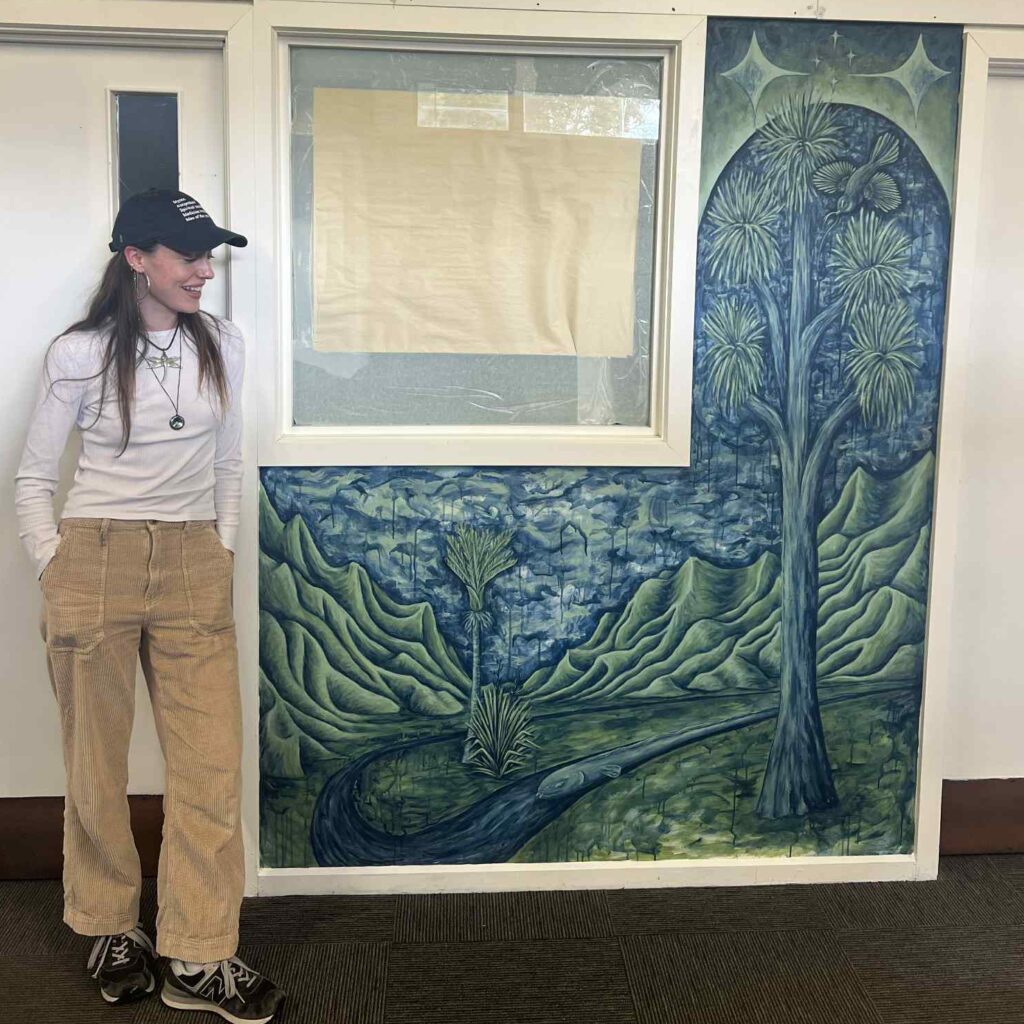
Olivia is a local artist from Ōtautahi Christchurch, specialising in paint and sculpture. Forever a creative spirit, Olivia originally abandoned art for law school. During the Covid lockdown, however, there was time aplenty and the paintbrush was once again wielded – and consequently never put down again. Self-taught by pouring over art history amongst countless hours of trial and error, she works best with acrylics and a sense of adventure beyond concrete reality. Olivia is intuitive and drawn to the surreal, specialising in surrealism and magical realism. Amongst her (many) favourite artists are Frida Kahlo, Remedios Varo, and Bill Hammond.
See more from Olivia
ABOUT THE ARTWORK
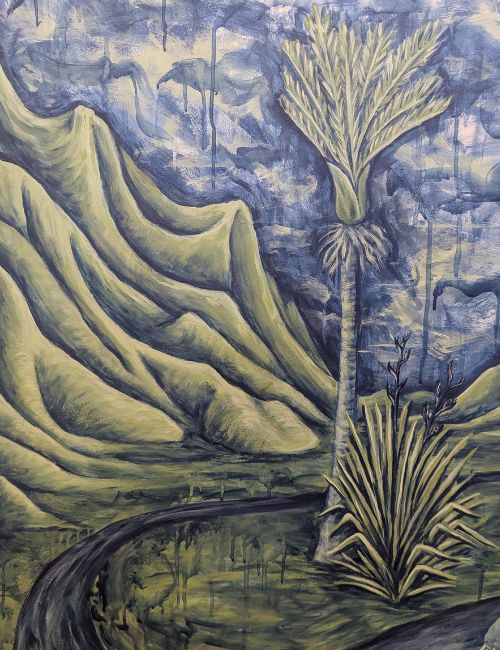
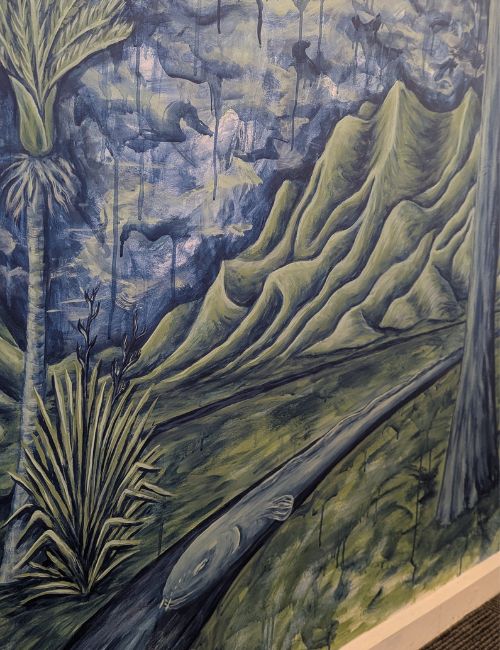
Take me to the river
ABOUT THE ARTWORK
Rebirth on another day of sun
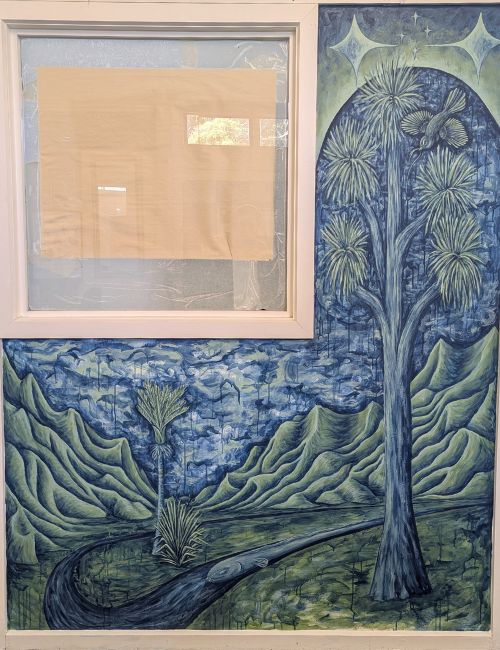
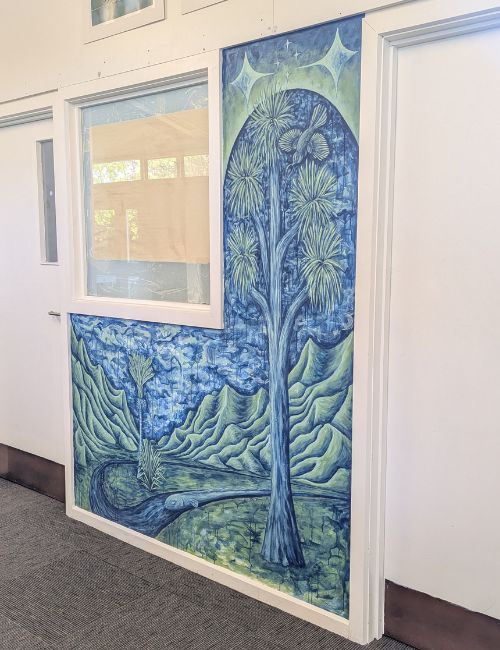
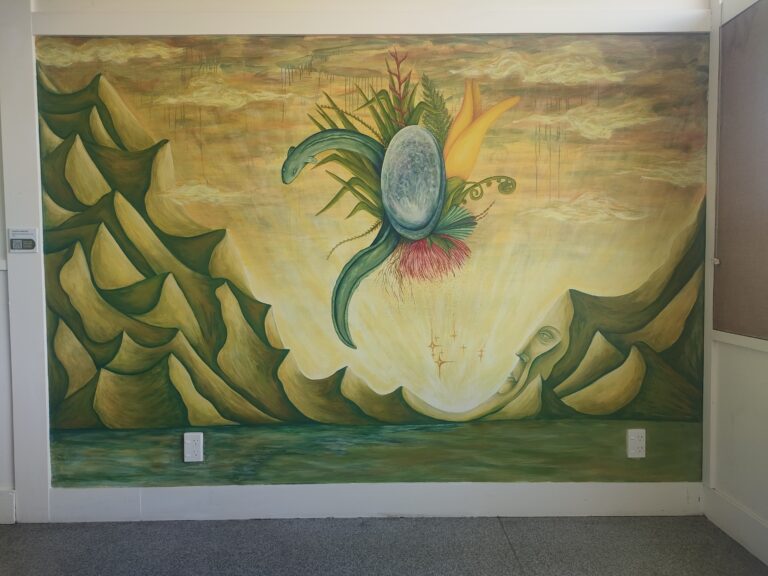
This work emphasises and explores the relationship between the real and the surreal, the ancient and the modern, birth and death. Working with the neighbouring views of the communal garden and playground, this piece takes direct influence from the whenua and merges the separate into the communal.
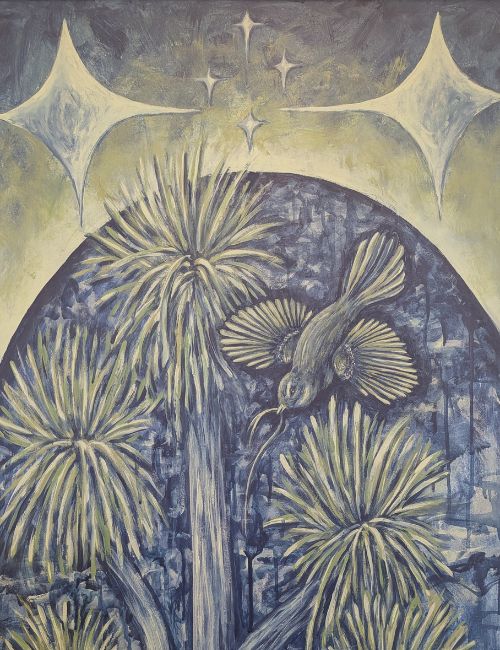
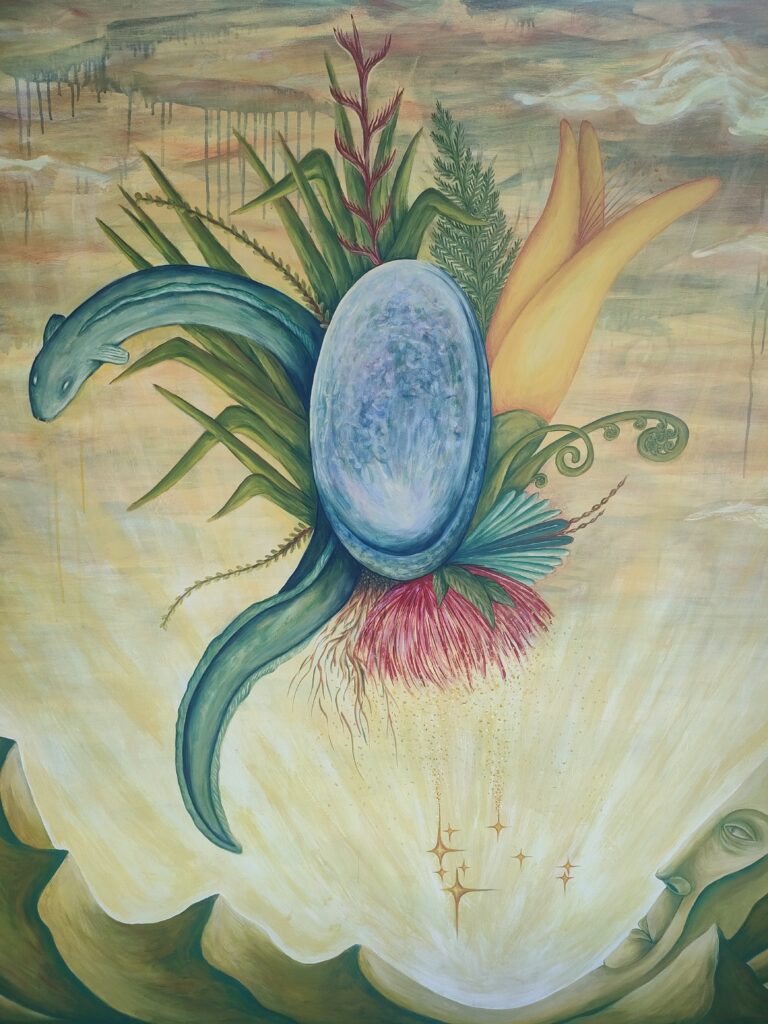
A floating motif of native plants and animals reimagines familiar kiwiana forms, giving them new life beyond tourist-shop clichés. Harakeke, kōrari, ferns, kōwhai, koru, a pīwakawaka tail, and a pōhutukawa flower weave together, the flower’s pollen melting downwards into the Matariki constellation, framed by the maunga.
The mountain’s faintly carved face takes inspiration from old rock art and carvings, cementing itself as a bridge between the ancient and its modern setting. The age of the maunga and their consequential peaceful wisdom helps give this work its quiet power and strength.
Beneath its spiritual layers, the scene captures that wonderfully familiar blissful summer evening after a day at the beach, freshly showered and sun-tired. Perhaps you’re resting on the deck, the lawn, or the couch, lazing around with a book or some music, a spread of chips and kiwi onion dip to tide you over till dinner. Bliss!
Cultural context & symbolism
Natural Elements
- Pāua are a well loved taonga, their dazzling shells difficult to emulate. They are associated with the stars, understood to be the eyes of ancestors gazing down.
- Eels (tuna) have always held a sentimental place in my heart and are able to live up to a century old. At the end of their long lives, they swim back to Tonga to reproduce and die. Their offspring float back to Aotearoa on ocean currents. Their ability to long stump scientists about their reproduction behaviours leans into their surreal, alien-like nature.
- Harakeke leaves fan the left side, with kōrari up top, neighbouring a fern.
- Kōwhai, one of our unofficial national flowers, included here alongside its leaves. A couple of korus reach out from the right, another classic emblem for Aotearoa and a well known symbol of new life and growth in Te Ao Māori.
- A pīwakawaka tail fans underneath, an omen of death in Māori mythology.
- At the bottom lies some loose roots next to a pōhutukawa flower, an icon of summertime, its pollen ends melting downwards into the Matariki constellation.
Matariki
Notably marking the beginning of the Māori new year, Matariki is a time for honouring and remembering the deceased. The full phrase, ngā mata o te ariki o Tāwhirimātea, translates to “the eyes of the god Tāwhirimātea”, who plucked his eyes out in anger at the separation of heaven and earth (Ranginui and Papatūānuku). Matariki refers to both the group of seven stars, and the star Matariki herself.
Each star has a name, a gender, a provenance, and a Greek equivalent. Key for this mural are the stars Hiwa-i-te-rangi (Celaeno) associated with growth and prosperity, and Pōhutukawa (Sterope) associated with the deceased. Hiwa is known as the wishing star, and the pōhutukawa star is of direct relation to the ancient tree from which spirits depart using Te Ara Wairua (the spirit’s pathway).
There is a belief that during the setting of Matariki spirits of the dead from the previous year are guided to the underworld, whereas during the rise of Matariki the spirits are carried from the underworld to become stars.
Te Rerenga Wairua
Unrealised until near completion, this work is reminiscent of the 1984 short film animation “Te Rerenga Wairua” and the spiritual journey after death that the wairua (life force) takes to Cape Reinga. This is where it reaches the ancient and sacred gnarly pōhutukawa, from which it leaps towards Hawaiki-Nui. Te Rerenga Wairua translates to the ‘leaping-off place of spirits’, and Reinga means ‘underworld’, underlining the belief that cape is where spirits enter “the world beyond the world of the living.”
The unconscious influence of Cape Reinga is reinforced by the meeting of the two seas at the bottom of the work. Intended as moana meeting grassy whenua, this interaction can also be interpreted as the clashing of the Tasman Sea and Pacific Ocean as seen from the cape.
This means, therefore, that the concepts of Matariki and Te Rerenga Wairua anchor this mural in the action of rebirth.